The revelation of Jesus Christ, which God gave him to show to his servants what must soon take place; and he made it known by sending his angel to his servant John, who bore witness to the word of God and to the testimony of Jesus Christ, even to all that he saw. Blessed is he who reads aloud the words of the prophecy, and blessed are those who hear, and who keep what is written therein; for the time is near. (Revelation 1:1-3)

 2024/10/14


165. Time Difference

The liturgical reforms following the Second Vatican Council shifted the Mass liturgy to a style in which the priest and the congregation encircle the altar. That was a big step towards the "fresh wineskins", of which Jesus said, "But new wine must be put into fresh wineskins" (Luke 5:38). Jesus said, "For this is the will of my Father, that every one who sees the Son and believes in him should have eternal life; and I will raise him up at the last day" (John 6:40), and prayed, "And this is eternal life, that they know thee the only true God, and Jesus Christ whom thou hast sent" (17:3). Herein lies the heart of the plan of salvation that the Father has entrusted to Jesus. So, to ensure that the step I mentioned above is taken forward, I would like to examine God's plan of salvation by following the life of John the Baptist. 

John the Baptist had been given the angel's announcement, "[H]e will go before him in the spirit and power of Eli'jah, to turn the hearts of the fathers to the children, and the disobedient to the wisdom of the just, to make ready for the Lord a people prepared" (Luke 1:17), his father Zachariah's prophecy "And you, child, will be called the prophet of the Most High; for you will go before the Lord to prepare his ways, to give knowledge of salvation to his people in the forgiveness of their sins" (1:76-77), and the word of God "The voice of one crying in the wilderness: Prepare the way of the Lord, make his paths straight. Every valley shall be filled, and every mountain and hill shall be brought low, and the crooked shall be made straight, and the rough ways shall be made smooth; and all flesh shall see the salvation of God" (3:4-6). He went before the Lord in the spirit and power of Elijah and gave the Lord's people knowledge of salvation in the forgiveness of their sins so that all men would see the salvation of God. 

The Gospel tells us that when people heard John the Baptist's voice, "Repent, for the kingdom of heaven is at hand" (Matthew 3:2), they came to him from Jerusalem, all Judea, and all the region around the Jordan, and were baptised by him in the river Jordan, confessing their sins, and that many Pharisees and Sadducees also came for baptism and heard his teaching (cf. 3:3-10). It further states that he also gave various exhortations to tax collectors and soldiers and preached good news to the people (cf. Luke 3:7-18). 

John also baptised Jesus and "saw the Spirit descend as a dove from heaven, and it remained on him" (John 1:32). He then deliberately led his disciples towards Jesus. The Gospel says: "The next day again John was standing with two of his disciples; and he looked at Jesus as he walked, and said, 'Behold, the Lamb of God!' The two disciples heard him say this, and they followed Jesus" (1:35-37). John prophesied that Jesus was the "Lamb of God, who takes away the sin of the world" (1:29), who "was before me" (1:30), who "baptizes with the Holy Spirit" (1:33) and "this is the Son of God" (1:34). 

Moreover, he realised that the true purpose for which Jesus was sent was to end the old covenant and fulfil the new covenant (the bride) and said: "He who has the bride is the bridegroom; the friend of the bridegroom, who stands and hears him, rejoices greatly at the bridegroom's voice; therefore this joy of mine is now full. He must increase, but I must decrease" (John 3:29-30). As Jesus said, "For all the prophets and the law prophesied until John; and if you are willing to accept it, he is Eli'jah who is to come" (Matthew 11:13-14), we see John the Baptist's resolution to bear the end of the old covenant prophecy in his words, "I must decrease". He, like Elijah, challenged the iniquity against God and was killed. 

Jesus asked his disciples, "Eli'jah does come first to restore all things; and how is it written of the Son of man, that he should suffer many things and be treated with contempt?" (Mark 9:12). This question was his own word of challenge to the suffering and death that Jesus, who alone knew its answer, would suffer to "save his people from their sins" (Matthew 1:21). Jesus had been carrying a plan to rescue "his people", the future of Christians, from the crumbling Jerusalem and transfer them to the new city so that everyone who sees the Son and believes in him would have eternal life and that he would raise them on the last day. It was a challenge, like a parent saving his child in exchange for his own life. Jesus, the Son of God, as a perfect human being, stamped his name on the forehead of the Roman Empire by undergoing the Roman Empire penalty of crucifixion. 

Pilate took water, washed his hands before the crowd and said, "I am innocent of this man's blood; see to it yourselves" (Matthew 27:24). But Jesus' thoughts had already captured the Roman Empire. The apostle Paul took God's grand plan on his shoulders and set foot on Roman soil according to Jesus' exhortation, "Take courage" (Acts 23:11). 

Meanwhile, to Pilate's words, the people responded in unison: "His blood be on us and on our children!" (Matthew 27:25). "His blood" is the blood of which Jesus said, "This is my blood of the covenant, which is poured out for many for the forgiveness of sins" (26:28). God is waiting for the day when the Old Covenant people, whom he had chosen and nurtured, will co-bear responsibility for this new "blood of the covenant" together with the Christians. Therefore, in the Book of Revelation, we have the following words. 

"It had a great, high wall, with twelve gates, and at the gates twelve angels, and on the gates the names of the twelve tribes of the sons of Israel were inscribed; on the east three gates, on the north three gates, on the south three gates, and on the west three gates. And the wall of the city had twelve foundations, and on them the twelve names of the twelve apostles of the Lamb" (Revelation 21:12-14). 

To be continued.

Maria K. M.


 2024/10/07


164. The Arrangement

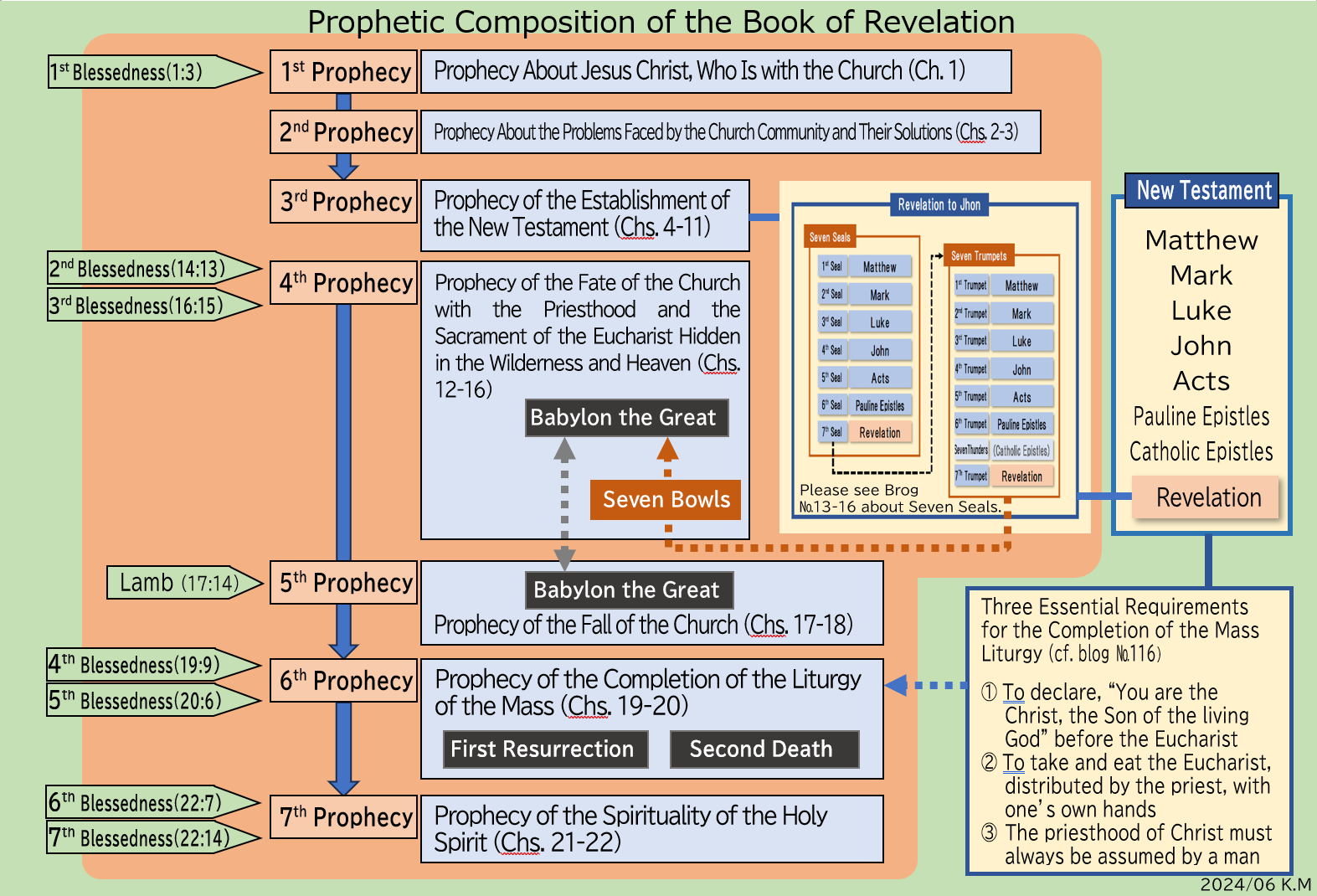
In the composition of San Damiano Crucifix, we can see two attainment stages in the Prophetic Composition of the Book of Revelation (see diagram below): the third prophecy, the Prophecy of the Establishment of the New Testament (chapters 4-11), and the sixth prophecy, the Prophecy of the Completion of the Liturgy of the Mass (chapters 19-20). In the centre of the crucifix, the image of Jesus, crucified and bleeding, implies the Eucharist. Additionally, the floating depiction of Christ's body expresses that the new covenant made by the blood of Jesus is made present by his words: "Do this in remembrance of me" (Luke 22:19). 

Here, the four people depicted on either side of the image of Jesus on the cross, which implies the Eucharist, are Jesus' mother, the "beloved disciple", the wife of Clopas, and Mary Magdalene, who were standing by the cross in John's Gospel (cf. John 19:25). In addition, the man at the far left of Jesus, standing beside them, looking up at Christ on the cross and marked below as a "centurion", represents the converted Roman Empire. The three fingers he is holding up are said to mean, in a Christian context, "I testify that Jesus is the Lord".1

 1. Michael Goonan (2000), The Crucifix That Spoke to St Francis, St Pauls Publications. 

These four people abide in the stage of the sixth prophecy of the Prophetic Composition of the Book of Revelation, the Prophecy of the Completion of the Liturgy of the Mass (chapters 19-20). The fact that they are depicted with Jesus in the middle, divided to the left and right, indicates the arrangement of the persons in the Mass liturgy. The wood of the cross is not distinctly depicted in this crucifix. That is because Christ's body represents the Eucharist, under which there should be an altar. On the right of Jesus, described as the Eucharist on the altar, are the mother of Jesus and the Apostle, the "beloved disciple" who took her into his house - the priesthood and the priest who received it. To the left, Clopa's wife represents the married believers, while Mary, called by her place name, Magdala, is thought to represent the single believers. 

In them, depicted on the right and left of the Eucharist, Jesus' following words are fulfilled: "But to sit at my right hand and at my left is not mine to grant, but it is for those for whom it has been prepared by my Father" (Matthew 20:23). These words are Jesus' answer to the request of the mother of the sons of Zebedee, who came to him with her two sons, prostrated herself and said, "Command that these two sons of mine may sit, one at your right hand and one at your left, in your kingdom" (20:21). The desire for power and control is no different for men and women. Even in today's globalised world, traditions of male domination and patriarchy remain and make it difficult to see true equality between men and women. 

Adam intended to gain authority and power by naming his wife Eve and ruling over her (cf. Genesis 3:20). Eve, when Cain was born, tried to sanctify herself and have authority, saying, "I have gotten a man with the help of the LORD" (4:1). Under these parents, Cain "rose up against his brother Abel, and killed him" (4:8) out of jealousy. The Gospel, concerning the incident of Zebedee's sons and their mother, tells us: "And when the ten heard it, they were indignant at the two brothers" (Matthew 20:24). John must never have forgotten that incident because he witnessed the negative cycle of human relationships to begin, even among the Apostles. 

People depicted to the right and left of the San Damiano Crucifix will be expressed as surrounding the Eucharist and the altar that supports it if rendered as a three-dimensional image. Such an arrangement allows them to see each other and to realise the following prayer of Jesus: "I in them and thou in me, that they may become perfectly one" (John 17:23). It makes their relationship more transparent and gradually creates new relationships that deter the negative cycle. The fact that various matters that the Church has kept hidden in its unique tradition are being brought to light today bears witness to this. As unbearable as these experiences have been, we, the Church, are indeed beginning a path of purification. The importance of the Mass liturgy in the form in which the faithful gather around the Eucharist and the altar that supports it lies not only because the institution of the Eucharist took place around the Passover table but also because of the above facts. 

I am a post-Vatican II believer and only know this style of Mass liturgy, where the priest and the congregation face each other around the altar. So, I was more than a little shocked when I learnt that it had been less than a century since the days when the Church celebrated the Mass liturgy in the style of everyone facing the altar. On the other hand, I was so happy to know that the Church, having made these reforms, had taken a big step towards the Prophecy of the Completion of the Liturgy of the Mass (chapters 19-20). Remembering these things, I thought back to Francis' time and gave it a lot of thought. 

To be continued.

Maria K. M. 


 2024/09/30


163. The Trace of Christ, the Son of God

St Francis gazed at the crucifix of San Damiano. He perceived in it the image of the Kingdom of God, depicted inspired much by John's Gospel and the Book of Revelation. The truth of the Kingdom of God he received is still transmitted to us 800 years later. 

Jesus on the cross in San Damiano is not in agony. That is because his image suggests the Eucharist. The Eucharist gives believers the knowledge of divine informationlessness. The Eucharist is partaken of by believers, giving them the experience of union with "Christ, the Son of God" and making them experience divine informationlessness. Therefore, believers must focus on the Eucharist, detaching the taste of the bread and wine from it, tasting the tastelessness of having received the Eucharist and remembering the divine informationlessness. Hence, believers need to mobilise all their senses in receiving the Eucharist. First, it is essential to look at the Eucharist raised by the priest and declare that it is the "Christ, the Son of God", so that they can make it fixed that the divine informationlessness in the Eucharist they are about to receive is of the "Christ, the Son of God" by hearing their own voice of declaration. Then, they take the consecrated Host distributed to them, touch it with their fingers, smell it and taste it in their mouths. 

The acquisition of such special knowledge is usually done unconsciously. No one can observe it, let alone the person in question. That is why we confess to the Eucharist just before receiving it so that the "Christ, the Son of God" remains as a trace in our unconscious realm. This trace becomes alive on the path of living the daily routine, from the end of that Mass with the blessing of the dispensation to the next Mass. That is because the Holy Spirit, sent in the name of Jesus, is constantly asking believers to collaborate with him so that he can work as Christ. The Holy Spirit continues to contact the believer to become the Christ. The faint touch at that time corresponds to the trace of divine informationlessness that the believer keeps in their unconsciousness realm through Communion. That is the trace of "Christ, the Son of God." 

In the experience of responding to the Holy Spirit, who is constantly seeking to collaborate with us, only "Yes" is always realised for the believer who desires it (cf. 2 Corinthians 1:17-22). Just as we voluntarily line up for Communion and take and eat the consecrated Host given by the priest, whenever we encounter the events on the path of living the daily routine from the blessing of the dispensation to the next Mass, we remember the sensation of divine informationlessness we had when having received Communion voluntarily and direct attention towards collaborating with the Holy Spirit. Then, we will see that the action we do next is different from when we do it alone by watching the process of doing it as Jesus said, "In that day you will know that I am in my Father, and you in me, and I in you" (John 14:20). 

For us humans, born as a mass of information and living amidst information, the only way to become poor in all information is to turn our consciousness to divine informationlessness. And the memory of having collaborated with the Holy Spirit makes us realise the blessedness that is given to the little ones who accept the washing of God. God thus wants believers to live in direct collaboration with the Holy Spirit without being dependent on anyone else. 

Here, another thing that is simultaneously necessary for working with the Holy Spirit is found in the following words of Jesus: "When the Spirit of truth comes, he will guide you into all the truth; for he will not speak on his own authority, but whatever he hears he will speak, and he will declare to you the things that are to come. He will glorify me, for he will take what is mine and declare it to you" (John 16:13-14). 

To know that the Holy Spirit takes what is of Jesus and declares it to us, we need to share the worldview of Jesus Christ, like the disciples who lived with him in reality. As seen in the disciples' activities after Pentecost, they realised and spoke of the prophecies of the Hebrew Scriptures through the worldview of Jesus Christ. It did not matter that they were "uneducated, common men" (Acts 4:13). In the same way, the worldview of Jesus Christ (see diagram below), injected into our memory from Revelation, evokes a profound empathy from the inner recesses of our memory when we come into contact with the words of the New Testament, making us realise that we know the truth. Finally, the Word, the words of life, flows out of our mouths, just as happened to the disciples at that time. 

To be continued 

Maria K. M.


 2024/09/23


162. My House

The crucifix of San Damiano, much inspired by the Gospel of John and the Book of Revelation, made a strong impression on Francis's vision, and he grasped it. It is said that he heard the voice saying, "Francis go and repair my house which, as you see, is all falling down", three times from the crucifix. He set about repairing the church building. 

When Jesus went up with his disciples to Jerusalem for Passover and saw in the temple those who were selling oxen and sheep and pigeons and the moneychangers at their business, he drove all the sheep and cattle out of the temple, scattered the money of the moneychangers and overturned their tables. Then he told those who sold the pigeons, "Take these things away; you shall not make my Father's house a house of trade" (John 2:16). It is written, "His disciples remembered that it was written, 'Zeal for thy house will consume me.'" (2:17). For Jesus, who said, "All that the Father has is mine" (16:15), the "Father's house" was "my house". The zeal for his house that the Father had was also Jesus'. Francis must have shared the zeal. 

Jesus, in this same scene, further responded to the Jews, saying, "Destroy this temple, and in three days I will raise it up" (2:19), as they pressed him saying, "What sign have you to show us for doing this?" (2:18). The Gospel explains that "he spoke of the temple of his body" (2:21). For Francis at that time, for us as well, "his body" is the Holy Eucharist. Hence, the command "Repair my house" was linked to the completion of the Mass liturgy. 

However, even though the New Testament had already been established more than 800 years earlier, the Church at that time was amidst the fourth prophecy of the Prophetic Composition of the Book of Revelation (see below), the Prophecy of the Fate of the Church with the Priesthood and the Sacrament of the Eucharist Hidden in the Wilderness and Heaven (Chapters 12-16). Furthermore, the course of history was about to lead the Church towards the fifth prophecy, the Prophecy of the Fall of the Church (chapters 17-18). In this interstice, using the subject of John's Gospel and Revelation, God showed Francis the entire Kingdom of God by visualising it. 

Francis saw the "truth" of the "Kingdom of God" on the crucifix of San Damiano and realised the "life". That was the life of Christ. He looked over the whole creation saved by the life of Christ. Then he looked back. He wanted to show the "way" to the "life" to those who sought it. Receiving the "Kingdom of God" as truth, he had in his mind two gospel themes about the "Kingdom of God": poverty and littleness. Jesus said, "Blessed are you poor, for yours is the kingdom of God" (Luke 6:20). He lived among such people, which is corroborated by Jesus' words when he sent his disciples (cf. Luke 9:3). The poverty became for Francis a concrete way of following Christ. 

Jesus also said, "Truly, I say to you, whoever does not receive the kingdom of God like a child shall not enter it" (Luke 18:17). That was when the disciples rebuked those who brought their children so that Jesus might touch them. The blessedness of those who accept the washing of God is in "getting touched by Jesus". Jesus' washing the disciples' feet was the act of "having loved his own who were in the world, he loved them to the end" (John 13:1). Thus, those who "receive the kingdom of God like a child" are the ones who see themselves as a little one whom God can wash at any time. 

Hence, Francis was convinced through the Words that being poor and least was a sign that pointed the "way" to the "truth" of the "Kingdom of God". He concentrated on that and lived it thoroughly. He lived his life with a direct belief in the words of Jesus: "I am the way, and the truth, and the life; no one comes to the Father, but by me" (John 14:6). Relying on his passion like this, God made him bear the cross of Jesus. It was the cross of San Damiano, painted with the Gospel of John and the book of Revelation as its subject. He undertook the name of Jesus and bore his love and "Kingdom of God". 

To be continued.

Maria K. M.


 2024/09/16


161. The Successor to the Apostle John

Recently, I learned that the composition motif on the San Damiano Crucifix, which is said to have spoken to Saint Francis, is based on the Gospel of John. I also realised that it contains particular messages, with scenes from the Book of Revelation inserted into it. 

The finger painted at the very top of the crucifix indicates that the kingdom of God has come, as Jesus said, "But if it is by the finger of God that I cast out demons, then the kingdom of God has come upon you" (Luke 11:20). The finger is pointing to one of the ten saints, who is holding a cylindrical object with buttons on it and is trying to hand it over to Jesus Christ, who is reaching his hand out from below. It is the scroll "sealed with seven seals" (Revelation 5:1). Therefore, this figure of Jesus Christ is the Lamb in Revelation and represents the Holy Spirit sent out in the name of Jesus, as written: "And between the throne and the four living creatures and among the elders, I saw a Lamb standing, as though it had been slain, with seven horns and with seven eyes, which are the seven spirits of God sent out into all the earth" (5:6). 

Revelation says, "[H]e [the Lamb] went and took the scroll from the right hand of him who was seated on the throne" (5:7), whereas, in the crucifix, the fingers of God's right hand point to the saint, and the Lamb is about to receive the scroll from the right hand of this saint. That is to draw our attention to the Book of Revelation because the scroll sealed with seven seals signified the New Testament (cf. blog №13-16). Also, the fact that two saints are depicted on either side of the crossbar means that, together with the ten saints mentioned above, these twelve saints are the twelve Apostles mentioned in Revelation: "And the wall of the city had twelve foundations, and on them the twelve names of the twelve apostles of the Lamb" (21:14). 

In addition, above the figure of Jesus Christ in the centre, the words "Jesus of Nazareth, King of the Jews" are written. They are the words of the inscription found only in the Gospel of John (cf. John 19:19) and of which when the chief priests asked Pilate, "Do not write, 'The King of the Jews,' but, 'This man said, I am King of the Jews.'" (19:21), Pilate refused to comply, replying, "What I have written I have written" (19:22). Pilate kept in mind that Jesus had not called himself the "King of the Jews" and that he had not answered when he asked, "Where are you from? " (19:9). At the same time, he asked Jesus "What is truth?" (18:38) and was afraid of the words "Son of God" (cf. 19:7-8). 

As we saw in the previous article, the Gospel of John, which shows the dialogue between Jesus and Pilate in a profound theological way, hints at the Roman Empire, which Jesus sought for Christians and to which Paul was sent. So, the Roman labelled "Centurion" is standing at the far right of the people drawn beside Jesus on the cross, and Christ's blood is also flowing down over him. Although the "Centurion" is not mentioned in the Gospel of John, this centurion is depicted as a symbol of the Roman Empire, which has become God's. 

The artist, painting the crucifix in this way, linking the Book of Revelation to the Gospel of John, seems to have seen John, the author of the Book of Revelation, and "the disciple whom he loved" as the same person. We can say so from the fact that the saint handing over the scroll above has a widow's peak and that the "disciple whom he loved" standing with Jesus' mother to the right of Jesus also has a widow's peak, and no one else does. The mother of Jesus and the beloved disciple, Mary Magdalene and Mary, the wife of Clopas, who are depicted on either side of Jesus on the cross, are witnesses to the fact that the blood and water flowed out when the soldier pierced Jesus' side with a spear after he drew his last breath (cf. 19:35). They are also the Church itself born from his side. 

The blood that pours down on these facts is the blood of the new and eternal covenant, which was poured out for many for the forgiveness of sins. Therefore, the Christ on the cross, depicted as appearing to be floating and gazing ahead, represents the Eucharist. His gaze is always asking those who look at the consecrated host the following question and waiting for an answer: "I am the resurrection and the life; he who believes in me, though he die, yet shall he live, and whoever lives and believes in me shall never die. Do you believe this?" (11:25-26). The only possible response is: "Yes, Lord; I believe that you are the Christ, the Son of God, he who is coming into the world" (11:27). 

The composition of the crucifix visualises the kingdom of God that appeared in the New Testament, as God's finger indicates. It is said that Francis perceived it, received it, and heard a voice. He was in the "Spirit" like John, the author of the Book of Revelation. He was baptised at birth with the name John. It is a strange coincidence. 

To be continued.

Maria K. M.


 2024/09/09


160. The Path to Rome

Jesus Christ was thinking of Rome for future Christians. We can barely find its clue from his conversation with Pontius Pilate. So, we need to observe, based on the Gospel, what was happening to Pilate when he came face to face with Jesus at that time. We still say his name as governor of the Roman Empire every time we recite the Creed. That is something special. 

When Pilate interrogated Jesus, he had a measure. That was the custom to release one prisoner whom Jews wanted at Passover. For Pilate, a Roman, whether Jesus was the Messiah did not matter, and there was no problem unless Jesus called himself "King of the Jews", based on Herod's reaction (cf. Luke 23:1-12). However, the following message delivered by his wife while Pilate was sitting in court must have been disturbing: "Have nothing to do with that righteous man, for I have suffered much over him today in a dream" (Matthew 27:19). Jesus replied to Pilate's interrogation saying, "My kingship is not of this world" (John 18:36) and "For this I was born, and for this I have come into the world, to bear witness to the truth. Every one who is of the truth hears my voice" (18:37). In the face of these words, which spoke of the divine reality clearly, Pilate asked back, "What is truth?" (18:38). At that moment, he had already become one who "hears my voice". 

The Gospel further states that when Pilate said, "I find no crime in him" (John 19:6), the Jews replied, "We have a law, and by that law he ought to die, because he has made himself the Son of God" (19:7), and that "When Pilate heard these words, he was the more afraid; he entered the praetorium again and said to Jesus, 'Where are you from?'" (19:8-9). The words "the Son of God" caught his ear. And it is written that "Pilate sought to release him" (19:12) when Jesus said, "You would have no power over me unless it had been given you from above; therefore he who delivered me to you has the greater sin" (19:11). By engaging in this way with the Roman governor Pilate at the end of his life, Jesus left a trail to Rome. That was the pass on which Jesus was appealed to by the chief priests, stood before the governor and king, and then headed for the cross. Paul headed for Rome following this same path as Jesus (cf. Acts 22:30-28:16).

After Jesus breathed his last on the cross, it is written that "Pilate wondered if he were already dead; and summoning the centurion, he asked him whether he was already dead. And when he learned from the centurion that he was dead, he granted the body to Joseph" (Mark 15:44-45). This centurion was the one who turned and stood beside Jesus as he breathed his last on the cross and said, "Truly this man was the Son of God!" (15:39). These words suggest that he had pondered upon that earlier. The centurion had once asked Jesus to heal a dying subordinate in Capernaum. When he asked for it, Jesus was impressed by his words, saying, "Truly, I say to you, not even in Israel have I found such faith" (Matthew 8:10). He then foretold of the coming of the New Jerusalem, saying, "I tell you, many will come from east and west and sit at table with Abraham, Isaac, and Jacob in the kingdom of heaven" (8:11), and added, "while the sons of the kingdom will be thrown into the outer darkness; there men will weep and gnash their teeth" (8:12), foretelling the impending fall of Jerusalem. 

The centurion, refusing Jesus' offer, "I will come and heal him" (8:7), asked only for his words of healing the subordinate. The insertion in the Gospel of the scene leading up to his saying, "Truly this man was the Son of God!" constitutes a prophecy of the future when only the Word would be carried to Rome after the Ascension and, in time, Jesus would eventually be recognised there as the Son of God. The conversion of the Roman Empire to Christianity guaranteed for Christians the spread of the new Bible and the opportunity to receive the new Jerusalem. That is as Jesus spoke in a parable: "But new wine must be put into fresh wineskins" (Luke 5:38). But the Church could not get away from the taste of "psalms, hymns and spiritual songs". So, the following words of Jesus were also fulfilled: "And no one after drinking old wine desires new; for he says, 'The old is good.'" (5:39). 

Maria K. M.


 2024/09/02


159. Vocation of the Apostle Paul

Paul says: "Put off your old nature which belongs to your former manner of life and is corrupt through deceitful lusts, and be renewed in the spirit of your minds, and put on the new nature, created after the likeness of God in true righteousness and holiness" (Ephesians 4:22-24). His experience of having encountered Jesus on the way to Damascus and being baptised with the help of Ananias gave him that realization. To "put on the new nature, created after the likeness of God" means rediscovering within oneself that one is made after the likeness of God and putting on the experience of being a new man in collaboration with the Holy Spirit. Living "in true righteousness and holiness" is also with the Holy Spirit. 

That is why Jesus said, "It is written in the prophets, 'And they shall all be taught by God.' Every one who has heard and learned from the Father comes to me" (John 6:45). As Jesus said, "But the Counselor, the Holy Spirit, whom the Father will send in my name, he will teach you all things, and bring to your remembrance all that I have said to you" (14:26), the "one who has heard and learned from the Father" is the one who learns from "the Holy Spirit, whom the Father will send in my name". 

Paul had experienced the Holy Spirit. On the other hand, Paul, who had not known Jesus directly like the other Apostles and did not have "all that I have said to you" in his memory, could not draw anything out of himself. The Apostle Paul was under a very different divine election from those whom Jesus had chosen to be his Apostles to share in his three years of public life, to encounter his Passion, Death, Resurrection and Ascension, and to experience the descent of the Holy Spirit. 

In these circumstances, he commanded Timothy, who had been familiar with the Hebrew Scriptures from his childhood, to "attend to the public reading of scripture, to preaching, to teaching" (1 Timothy 4:13) and taught him: "[The sacred writings] are able to instruct you for salvation through faith in Christ Jesus. All scripture is inspired by God and profitable for teaching, for reproof, for correction, and for training in righteousness" (2 Timothy 3:15-16). The very wisdom that leads to "salvation through faith in Christ Jesus" is what Paul believed he possessed. 

God chose him and led him in such a way that everything about him was for his good. Among "everything" he wrote about when he said, "Indeed I count everything as loss because of the surpassing worth of knowing Christ Jesus my Lord" (Philippians 3:8), were his belief in the resurrection as a Pharisee, his Roman citizenship as a native of Tarsus, and his profession as a tentmaker. Paul put to use all these as blessings from God a lot. Hence, he could say, "[O]ne thing I do, forgetting what lies behind and straining forward to what lies ahead, I press on toward the goal for the prize of the upward call of God in Christ Jesus" (3:13-14). Thus, the end of the fourth century, with the establishment of the New Testament canon and Christianity's becoming the state religion of the Roman Empire, was an extension of Paul's "I press on towards my goal". 

Having already foretold the fall of the Jerusalem temple, Jesus was preparing the "New Jerusalem" for future Christians. It was Paul's vocation to pave that way towards Rome. Hence, Jesus stood by Paul in the barracks of the tribune and commanded him: "Take courage, for as you have testified about me at Jerusalem, so you must bear witness also at Rome" (Acts 23:11). The Lord keeps the door open for Paul (cf. 1 Corinthians 16:8-9; 2 Corinthians 2:12; Colossians 4:3). 

In the letters to the seven churches in the Book of Revelation, the following verse is found: "I know your works. Behold, I have set before you an open door, which no one is able to shut; I know that you have but little power, and yet you have kept my word and have not denied my name" (Revelation 3:8). Accordingly, his reward is as follows: "He who conquers, I will make him a pillar in the temple of my God; never shall he go out of it, and I will write on him the name of my God, and the name of the city of my God, the new Jerusalem which comes down from my God out of heaven, and my own new name" (Revelation 3:12). 

Maria K. M.


Most Favourite